Cut to Black: The Slow Erosion of Editing as a Creative Discipline in British Television
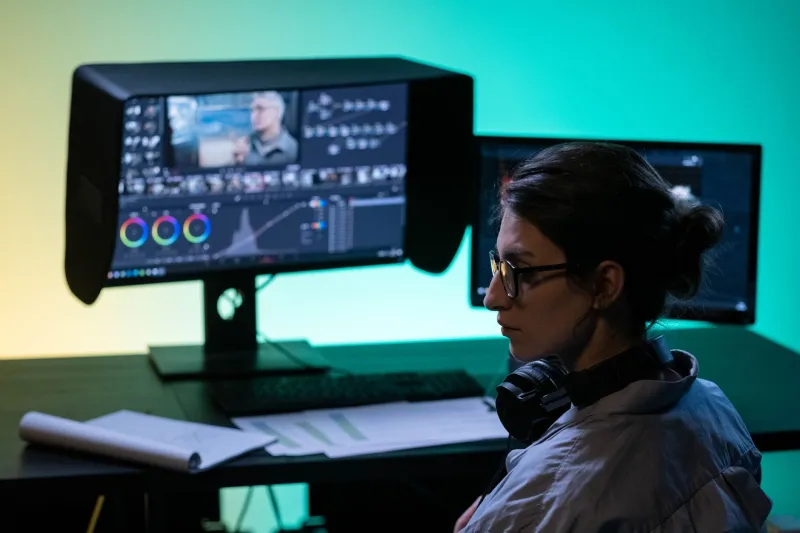
There is a moment in any well-edited drama when time itself seems to bend. A glance held a fraction too long. A cut to silence where music might have been expected. A scene that ends before the dialogue does, trusting the audience to carry the emotional weight forward on their own. These are not accidents. They are decisions — considered, argued over, and refined across weeks of work in a darkened suite. And increasingly, British television is running out of time to make them.
The editing room has always been television's best-kept secret. Audiences discuss performances, direction, and scripts with fluency. Rarely do they discuss the cut. Yet editors — those who sit with the assembled footage long after the director has moved on — are, in many respects, the final authors of what reaches the screen. Their choices govern pace, tension, and the subtle grammar through which stories are told. When that grammar degrades, something essential is lost, even if viewers cannot always articulate precisely what.
The Compression Problem
Over the past decade, post-production timelines in British television drama have contracted significantly. Where a prestige six-part series might once have afforded its editing team four to six months in the cutting room, industry professionals now describe schedules that allow little more than half that. The pressure originates from multiple directions simultaneously: tighter commissioning budgets, platform delivery deadlines, and a broader cultural acceleration that has reframed speed as a virtue rather than a compromise.
Veteran editor Margaret Holloway, whose credits span three decades of British drama from Channel 4 films through to recent BBC One productions, describes the shift in unambiguous terms. "The expectation used to be that you would live with the material," she explains. "You would watch the rushes, sit with your instincts, try things that you weren't sure would work. That exploratory period was where the real craft happened. Now there is no exploratory period. You are assembling against a clock from the moment the first footage arrives."
This compression is not merely an inconvenience for editors. It fundamentally alters the nature of the decisions being made. Instinct — refined through experience — is replaced by efficiency. The question shifts from what serves this story best to what can we deliver on time.
What Speed Costs
The consequences are visible to anyone paying close attention, though they manifest in ways that resist easy categorisation. Scenes that outstay their welcome. Emotional beats that arrive before the audience has been adequately prepared for them. Dramatic reveals that land with less impact than the material warrants, because the preceding rhythm has not been calibrated to create the necessary anticipation.
There is also the matter of performance. Editing and acting are, contrary to popular assumption, inseparable disciplines. A performance that appears flat in isolation can be transformed by the cut that precedes it; a powerful reading can be undermined by holding on the actor a moment too long. Editors, when given sufficient time, act as a second layer of direction — shaping performances in post that were only partially realised on set. When that time is denied, those performances are delivered to screen as found, rather than as shaped.
David Kaur, who has edited across drama, documentary, and factual entertainment for broadcasters including ITV and Channel 5, argues that the problem is compounded by a structural misunderstanding of what editing actually involves. "Commissioners and executives sometimes speak about editing as though it is essentially a technical process — assembling footage in the correct order," he says. "It is not. It is a creative process that requires iteration. You need to try the wrong version to understand why the right version works. That takes time that simply is not being allocated."
Training the Next Generation
If the immediate consequences of accelerated schedules are felt in the quality of finished programmes, the longer-term implications concern the transmission of craft itself. Editing, like many skilled disciplines, is learned through proximity — through working alongside experienced practitioners who can demonstrate not just technique but judgement. The compression of post-production timelines has eroded the space in which that transmission can occur.
Assistant editors, who traditionally developed their skills by observing and collaborating with senior colleagues across extended cutting periods, now frequently find themselves managing technical logistics under time pressure rather than absorbing creative methodology. The apprenticeship model, informal as it always was, is being quietly dismantled by the economics of contemporary production.
Organisations including the British Film Institute and ScreenSkills have acknowledged the skills gap in post-production, but industry professionals suggest that training initiatives, however well-intentioned, cannot substitute for the conditions of genuine creative practice. Craft is not transmitted through courses alone. It is transmitted through work.
Rethinking the Invisible
There is, perhaps, a broader cultural argument to be made here. British television has long prided itself on the quality of its storytelling — a reputation built not only on the strength of its writing and performance but on the cumulative craft of every discipline involved in production. Editing is foundational to that reputation in ways that are rarely acknowledged publicly.
The invisibility of editing — its success measured precisely by how little attention it draws to itself — has allowed its devaluation to proceed largely without comment. Audiences notice when a performance is poor. They notice when a script is weak. They do not always notice when the editing is merely adequate rather than exceptional, even as they feel the difference in their engagement with the material.
For British broadcasters navigating a period of significant financial and structural pressure, the temptation to treat post-production as a variable cost — something to be trimmed when budgets require adjustment — is understandable. It is also, in the view of those who work within the discipline, a false economy. The investment in editing time is not a luxury appended to the production process. It is, in a very literal sense, where the programme is finally made.
The silence between scenes, when it is working, is one of television's most powerful tools. It would be a considerable loss to allow that silence to become merely the sound of a craft running out of time.