Building Worlds Nobody Notices: The Quiet Genius of British Television's Production Designers
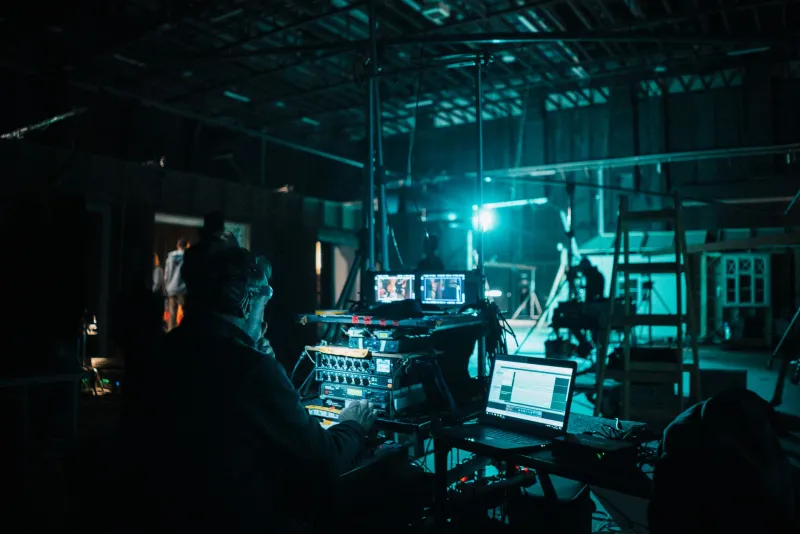
There is a particular irony at the heart of production design. The better the work, the less anyone tends to notice it. When a production designer builds a convincing Edwardian drawing room, a rain-soaked Glasgow housing estate, or a near-future government ministry that feels both plausible and faintly menacing, the audience simply accepts the world as given. The craft disappears into its own success. And in British television, that invisibility has become something altogether more troubling — not a mark of excellence, but a symptom of institutional neglect.
Production designers are, in the bluntest terms, the professionals who build what the camera sees. They conceive and oversee the physical environments in which drama unfolds: the architecture, the furniture, the colour palettes, the texture of surfaces, the relationship between space and character. In collaboration with directors and directors of photography, they are responsible for the visual language of a production in ways that go far beyond mere decoration. Yet within British television's own hierarchy of recognition — its awards circuits, its commissioning conversations, its industry profiles — the production designer remains a curiously marginal figure.
The Architecture of Storytelling
Ask any experienced production designer about their role and the word that recurs, with striking consistency, is storytelling. Not aesthetics. Not logistics. Storytelling.
"The set is never neutral," says one senior designer who has worked across several of the BBC's most lauded period dramas. "Every choice — the height of a ceiling, the warmth of a light source, whether a room feels cluttered or bare — tells the audience something about the character who inhabits it, the world they live in, the power dynamics at play. If those choices are made carelessly, or not made at all, the drama loses a layer of meaning that no amount of good writing or acting can fully recover."
This is not an abstract claim. Consider the difference between the suffocating domestic interiors of a production like Happy Valley — where cramped kitchens and low ceilings communicated the weight of working-class Yorkshire life as powerfully as any line of dialogue — and the airy, aspirational spaces of a drama that places its characters in environments that feel generic, interchangeable, vaguely Scandinavian in their blankness. The former is the product of deliberate creative intelligence. The latter is what happens when production design is treated as a procurement exercise.
Budget Pressures and the Erosion of Ambition
The financial pressures bearing down on British television production are well-documented and, by now, wearily familiar to those working within the industry. What is less frequently discussed is the disproportionate impact those pressures tend to have on the design department.
When a production faces cuts — and in the current climate, virtually every production faces cuts — certain line items are perceived as more defensible than others. Writer fees, lead actor contracts, and key technical roles tend to be protected, at least in principle. The design budget, by contrast, is often treated as a reservoir of contingency funds: something that can be drained incrementally without visible consequence. The logic is seductive and, in the short term, not entirely wrong. Audiences rarely walk away from a drama complaining that the wallpaper felt insufficiently researched.
But the cumulative effect of this approach is corrosive. Shortened prep times mean designers have fewer weeks to develop and test their visual concepts before shooting begins. Reduced budgets mean compromises on materials, on build quality, on the ability to create bespoke elements rather than falling back on hired stock. And the compression of timelines — a growing feature of British television production as commissioners chase faster turnarounds — means that the iterative, collaborative process through which great design emerges is increasingly squeezed out of existence.
"You used to have conversations," reflects one designer who has worked on flagship ITV and Channel 4 productions. "Real conversations, over weeks, with the director and the writer, about what kind of world this is and what it should feel like. Now you're lucky to get a couple of days before you're expected to be building. The creative thinking gets replaced by practical problem-solving, and the work is poorer for it."
A Recognition Gap That Speaks Volumes
The awards landscape tells its own story. The BAFTAs, for all their prominence in the British television calendar, offer a Production Design category that receives a fraction of the public and media attention lavished on acting, writing, and directing. The craft awards ceremony, where design is recognised, is a lower-profile affair — valued within the industry but largely invisible to the wider public conversation that shapes how television talent is understood and celebrated.
This matters for reasons beyond vanity. Recognition drives recruitment, sustains career trajectories, and signals to commissioners and studios where creative value is understood to reside. When production design is perpetually relegated to the margins of the awards conversation, it reinforces a hierarchy that treats visual world-building as a technical support function rather than a primary creative discipline.
Comparisons with the film industry are instructive, if uncomfortable. British cinema has long celebrated its production designers — Ken Adam's work on the Bond films, for instance, or the late John Box's contributions to Lawrence of Arabia and Oliver!, remain part of the cultural record. Television has produced designers of equivalent stature and imagination, but the industry has done conspicuously little to ensure they receive equivalent acknowledgement.
The Fight to Be Heard
For the designers themselves, the challenge is partly professional and partly philosophical. Many describe a quiet but persistent battle to be included in the creative conversation at the earliest possible stage — to be present in the room when the fundamental questions about a drama's identity are first being asked, rather than arriving later to execute decisions already made.
"The worst thing that can happen is when you're brought in after the scripts are locked and the director has already formed strong visual ideas without any input from design," says one designer whose credits span prestige streaming drama and terrestrial long-runners. "You become an executor rather than a collaborator. And the work reflects that."
There is, it should be noted, genuine cause for optimism in certain corners of the industry. A number of British streaming productions — benefiting from higher budgets and, in some cases, greater creative autonomy — have invested seriously in production design and reaped visible rewards. The visual distinctiveness of several recent prestige dramas has been widely praised, even if the designers responsible remain unnamed in most critical coverage.
The question is whether these represent a sustainable shift in how the industry values this craft, or merely isolated pockets of good practice within a broader culture of indifference.
An Industry That Must Look at Itself
British television has always taken legitimate pride in the quality of its storytelling. The writers' room, the actor's craft, the director's vision — these are the pillars around which the industry's self-image is constructed. But a drama is not built from words and performances alone. It is built, quite literally, from the ground up: from the spaces that characters inhabit, the objects that surround them, the visual world that tells the audience, before a single line is spoken, what kind of story this is going to be.
Production designers build that world. They deserve to be recognised as the architects they are — not merely the invisible hands that dress a set, but the creative intelligence that gives British television drama its sense of place, its visual identity, and its capacity to make the invented feel real. The industry's failure to acknowledge this is not simply an oversight. It is a choice, and one with consequences that accumulate quietly, drama by drama, until the worlds on screen begin to feel a little less vivid, a little less specific, a little less alive.